
The short answer:
- The BLUETTI Elite 30 V2 is the best affordable compact solar generator in this comparison because it combines a 288Wh LiFePO4 battery with 600W of continuous AC output in a 9.5-pound package.
- The ALLWEI 500W is the budget-capacity pick when it costs materially less than the better-known 500Wh competitors.
- For larger appliances and home backup, the Anker SOLIX C1000 is the best all-around 1kWh choice thanks to its 1,800W inverter, fast charging, 600W solar input and optional expansion to 2,112Wh.
I compared 11 current power stations across three useful size classes. Each winner solves a different problem: ultralight backup, inexpensive mid-size capacity or serious 1kWh emergency power. Do not choose by watt-hours alone; inverter output, charging speed, weight, battery life, warranty and current sale price can change the better buy.
Quick Picks: The Best Affordable Solar Generators for 2026
| If you want… | Best choice | Why it wins | Main trade-off |
|---|---|---|---|
| Compact power around 300Wh | BLUETTI Elite 30 V2 | 600W output, 200W solar input, app control and tested UPS performance at about 9.5 lb | 288Wh is for short runtimes, and the case is rated IP20 rather than weather-resistant |
| The most budget-friendly 500Wh capacity | ALLWEI 500W | 512Wh LiFePO4 capacity, 500W output, UPS mode and 100W USB-C in a 13 lb unit | Slower charging and a smaller support ecosystem than the major-brand alternatives |
| An expandable 1kWh home-backup unit | Anker SOLIX C1000 | 1,800W output, 600W solar input, app control and expansion to 2,112Wh | Heavier than the BLUETTI and Jackery models in its comparison group |
My overall pick is the Anker SOLIX C1000 if the budget and 28.4-pound weight are acceptable. It can run a much wider range of household appliances than either smaller winner. For camping, electronics and short outages, the Elite 30 V2 is much easier to carry. The ALLWEI earns its place on price-to-capacity value, but only when its live price is meaningfully below the EcoFlow, Jackery and BLUETTI alternatives.
What This Comparison Covers
- How I selected and ranked the models
- Winner specifications at a glance
- Lifetime value comparison
- Estimated real-world runtimes
- BLUETTI Elite 30 V2 and 300Wh competitors
- ALLWEI 500W and 500Wh competitors
- Anker SOLIX C1000 and 1kWh competitors
- Which solar generator should you buy?
- Frequently asked questions
How I Ranked These Solar Generators
I placed the products into approximately 300Wh, 500Wh and 1,000Wh classes, then evaluated the models within each class. My ranking considers:
- Usable capacity: Advertised watt-hours plus a realistic allowance for inverter losses.
- Continuous inverter output: The AC load the unit can support continuously—not only a promotional surge or power-lifting figure.
- Battery chemistry and cycle claim: All three winners use long-life LiFePO4 batteries.
- Recharge speed: Wall and solar input limits, because a large battery is less useful if it cannot be replenished efficiently.
- Portability: Weight, dimensions and how the unit fits its likely use.
- Outputs and controls: AC outlets, high-power USB-C, UPS behavior, wireless app access and expansion support.
- Ownership value: Current price, warranty, documentation and manufacturer support relative to the competition.
Testing disclosure: I physically tested the BLUETTI Elite 30 V2, including AC charging, solar charging, Power Lifting and UPS behavior. You can see the measurements and test setup in my BLUETTI Elite 30 V2 review. The ALLWEI and Anker recommendations are based on current manufacturer documentation, listing data and comparative analysis, not my own controlled bench test. Specifications can change by region or product revision, so confirm the seller’s listing before ordering.
For background on the terms used here, see my guides to battery capacity, battery cycle life and solar-panel sizing.
Winner Comparison: Capacity, Output and Charging
BLUETTI Elite 30 V2

- Capacity
- 288Wh
- AC Output
- 600W continuous
- Weight
- About 9.5 lb
- Max Solar Input
- 200W
- Charging Highlight
- About 45 minutes to 80% in my AC test
- Best Use
- Camping, electronics and light emergency loads
ALLWEI 500W

- Capacity
- 512Wh
- AC Output
- 500W continuous / 1,000W surge
- Weight
- About 13 lb
- Max Solar Input
- 120W
- Charging Highlight
- About 2.5 hours by AC
- Best Use
- Budget mid-size backup
Anker SOLIX C1000

- Capacity
- 1,056Wh
- AC Output
- 1,800W continuous
- Weight
- About 28.4 lb
- Max Solar Input
- 600W
- Charging Highlight
- Advertised 58-minute full AC charge
- Best Use
- Appliances, outages and expandable backup
The capacity figure tells you approximately how much energy is stored. The inverter rating tells you whether the power station can start and run the appliance. A 1,056Wh battery does not automatically run every device; the device’s continuous draw and startup surge must remain within the power station’s supported limits.
Lifetime Value Comparison
A low purchase price does not automatically mean a low ownership cost. A battery rated for more cycles may deliver substantially more total energy before reaching its published cycle-life threshold. This comparison combines each model’s price, capacity and cycle rating to estimate how much AC energy it could deliver over that rated period.
Battery capacity multiplied by cycle life is best described as nominal lifetime energy throughput, not usable power. The calculation must still account for capacity fade and AC inverter losses. I used a different capacity-retention factor for the ALLWEI because its cycle rating ends at 70% rather than 80%.
| Model | BLUETTI Elite 30 V2 | ALLWEI 500W | Anker SOLIX C1000 |
|---|---|---|---|
| Price snapshot | $218.98 | $299.00 | $469.99 |
| Capacity | 288Wh | 512Wh | 1,056Wh |
| Rated cycles | 3,000 to 80% | 3,000 to 70% | 3,000 to 80% |
| Nominal lifetime energy | 864kWh | 1,536kWh | 3,168kWh |
| Est. delivered AC energy | 661.0kWh | 1,109.8kWh | 2,423.5kWh |
| Est. cost per delivered AC kWh | $0.33 | $0.27 | $0.19 |
Calculation method:
- Nominal lifetime energy = battery capacity x rated cycles.
- Average remaining-capacity factor = the average of 100% and the published end-of-cycle threshold.
- Elite 30 V2 and Anker C1000 estimated delivered AC energy = nominal lifetime energy x 0.90 average remaining capacity x 0.85 inverter efficiency.
- ALLWEI estimated delivered AC energy = nominal lifetime energy x 0.85 average remaining capacity x 0.85 inverter efficiency.
- Estimated cost per delivered AC kWh = price snapshot divided by estimated delivered AC energy.
What the original calculation shows: At these prices, the Anker SOLIX C1000 offers the lowest estimated lifetime AC-energy cost at approximately $0.19/kWh. That is about 28% lower than the ALLWEI and 41% lower than the Elite 30 V2. The ALLWEI ranks second at approximately $0.27/kWh, while the smaller BLUETTI costs approximately $0.33/kWh over its rated cycle period.
This does not mean the C1000 is automatically the best purchase for every user. A person who only needs to charge electronics may save money and carry nearly 19lb less by choosing the Elite 30 V2. The calculation measures long-term energy value; it does not measure portability, convenience or whether a buyer will actually complete 3,000 full equivalent cycles.
The capacity-retention factors assume degradation progresses approximately from 100% to the published threshold across the rated period. Real degradation is not perfectly linear, and efficiency changes with load, temperature, standby draw and battery condition. These figures are original comparison estimates, not guarantees.
A battery reaching its cycle threshold is also not dead. A rating such as “3,000 cycles to 80%” means the manufacturer expects the battery to retain approximately 80% of its original capacity at that point under its test conditions. It may continue operating for years at reduced capacity.
Estimated Real-World Runtimes
The estimates below use 85% of advertised capacity to allow for typical AC inverter losses:
Estimated runtime = battery capacity x 0.85 / device wattage
| Example device | Assumption | Elite 30 V2 | ALLWEI 500W | Anker C1000 |
|---|---|---|---|---|
| Wi-Fi router | 10W continuous | About 24.5 hours | About 43.5 hours | About 89.8 hours |
| CPAP machine | 40W average | About 6.1 hours | About 10.9 hours | About 22.4 hours |
| Laptop battery | 60Wh per charge | About 4.1 charges | About 7.3 charges | About 15 charges |
| LED television | 100W continuous | About 2.4 hours | About 4.4 hours | About 9 hours |
| Mini refrigerator | 60W average | About 4.1 hours* | About 7.3 hours* | About 15 hours* |
Actual runtime changes with temperature, battery age, standby draw and the efficiency of the connected appliance. CPAP humidifiers and heated tubes can substantially increase power use. A portable power station is not a medical device, so leave a generous safety margin for critical overnight equipment. Use my power-station runtime calculator for your own numbers.
1. BLUETTI Elite 30 V2: Best Compact 300Wh Solar Generator

BLUETTI Elite 30 V2 | 600W 288Wh – Elite 30 V2
from: BLUETTI US
Why it wins: The Elite 30 V2 provides twice the continuous AC output of the other two models in this class while remaining under 10 pounds. Its 600W inverter, 140W USB-C port, 200W solar input, Wi-Fi/Bluetooth app controls and UPS mode make it unusually capable for a 288Wh unit.
What My Elite 30 V2 Testing Found
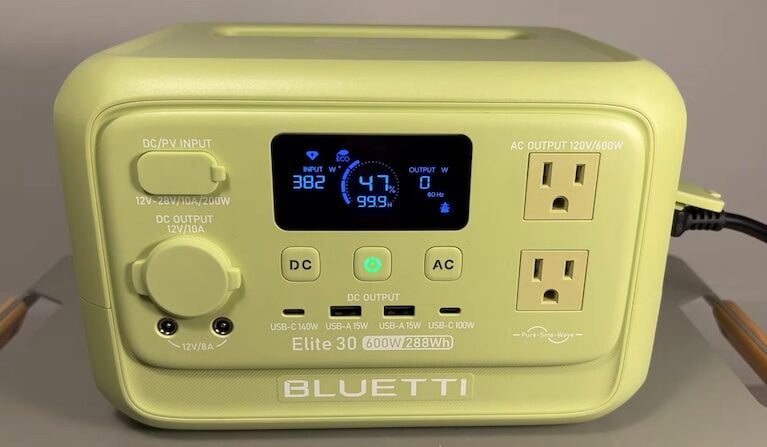
In my hands-on test, AC charging reached roughly 80% in about 45 minutes. One solar panel initially produced around 50–60W, then reached about 93W after I enabled high-current mode in the BLUETTI app. With two panels, input climbed to roughly 180W. That makes the app more than an optional convenience for users who want the highest solar input from certain panel setups.
The 800W Power Lifting mode ran a resistive steamer in my test, but a roughly 1,000W vacuum cycled and was not stable. That distinction matters: Power Lifting can reduce voltage to support some heaters and other resistive loads, but it does not turn the unit into a true 800W or 1,000W inverter for motors or sensitive electronics. Treat 600W as the normal continuous AC ceiling.
UPS transfer produced no visible flicker in my test. The limitation is capacity: 288Wh is excellent for phones, laptops, network gear, lights and brief appliance use, but not for running large loads for many hours. The IP20 enclosure also has no meaningful water protection, so keep it sheltered.
300Wh Category Comparison
BLUETTI Elite 30 V2
- Capacity
- 288Wh
- Continuous AC
- 600W
- Weight
- About 9.5 lb
- Key Advantage
- Highest normal AC output and 200W solar input
Jackery Explorer 300

- Capacity
- 292Wh
- Continuous AC
- 300W
- Weight
- About 7.5 lb
- Key Advantage
- Lightest and slightly more advertised capacity
Anker SOLIX C300

- Capacity
- 288Wh
- Continuous AC
- 300W
- Weight
- About 9.1 lb
- Key Advantage
- Strong port selection and 140W two-way USB-C
Why not the Jackery or Anker? The Jackery is the easiest to carry, and the current listing tied to this ASIN advertises an updated LiFePO4 battery. The Anker C300 is polished and versatile. Neither, however, matches the BLUETTI’s 600W continuous output. That extra headroom is the most meaningful difference when the three capacities are nearly identical. Because the long-running Jackery ASIN has been used for more than one listing revision, verify the chemistry and specifications shown by the seller at checkout.
Pros:
- 600W continuous inverter in a compact 288Wh unit
- Fast AC charging and up to 200W solar input
- 140W USB-C, UPS mode and useful app settings
- Hands-on performance matched the intended light-duty use
Cons:
- Limited energy storage for long outages
- Power Lifting is not equivalent to higher normal inverter output
- IP20 enclosure must be protected from water and dust
Best for: Campers, remote workers and apartment dwellers who want a compact unit for electronics, connectivity, lights and short emergency loads.

BLUETTI Elite 30 V2 Portable Power Station | 600W 288Wh (Twilight Glow Purple) Elite 30 V2 Twilight Glow Purple
Lightweight (4.3kg), 288Wh/600W solar power station with 9 ports, UltraCell™ tech, 1500W surge, ideal for camping, travel, backup.

2. ALLWEI Portable Power Station 500W: Best Budget 500Wh Capacity

Why it wins: The ALLWEI combines a 512Wh LiFePO4 battery, 500W inverter, 100W USB-C output and UPS function in a roughly 13-pound enclosure. Its appeal is straightforward: it offers a full 512Wh of capacity at a price that is often lower than comparable models from EcoFlow, Jackery and BLUETTI.
Check the ALLWEI 500W on Amazon
ALLWEI publishes a 500W continuous and 1,000W surge rating, about 2.5 hours for AC recharging and a 120W solar-input limit. The current product page claims 3,000+ battery cycles. That is respectable budget performance, but the 120W solar ceiling and slower wall charging are behind several competitors.
500Wh Category Comparison
ALLWEI 500W
- Capacity
- 512Wh
- AC Output
- 500W / 1,000W surge
- Weight
- About 13 lb
- Published Cycle Claim
- 3,000+ claimed
- Charging Advantage
- Budget price and 100W USB-C
EcoFlow RIVER 2 Max

- Capacity
- 499Wh
- AC Output
- 500W / 1,000W surge
- Weight
- About 13.2 lb
- Published Cycle Claim
- 3,000 cycles to 80%
- Charging Advantage
- About one-hour AC charging and 220W solar
Jackery Explorer 500 v2

- Capacity
- 512Wh
- AC Output
- 500W / 1,000W surge
- Weight
- About 12.6 lb
- Published Cycle Claim
- 6,000 cycles to 70%
- Charging Advantage
- Advertised full AC charge in about 80 minutes
BLUETTI AC50B

- Capacity
- 448Wh
- AC Output
- 700W continuous
- Weight
- About 14.8 lb
- Published Cycle Claim
- 3,500+ cycles
- Charging Advantage
- About 45 minutes to 80% and app control
This is a price-dependent recommendation. The ALLWEI does not lead this group in inverter power, solar input, charging speed, cycle claim or software. The BLUETTI AC50B has a stronger 700W inverter, the EcoFlow charges faster and accepts more solar, and the Jackery publishes the longest cycle-life figure. Choose the ALLWEI when it is materially cheaper and you value capacity over those extras. If the price gap is small, one of the major-brand alternatives may be the better long-term purchase.
Also verify the exact port layout on the listing. ALLWEI has sold closely related PPS600-1 packages, and product pages do not always count outputs the same way. The ASIN in this comparison is B0CCNTFDJJ.
Pros:
- 512Wh LiFePO4 battery at a competitive budget price
- 500W continuous output and 1,000W surge rating
- 100W USB-C output and UPS function
- About 13 lb, which is reasonable for this capacity
Cons:
- Only 120W of published solar input
- Slower AC recharge than the comparison leaders
- Smaller service, accessory and app ecosystem
- Specifications can vary among similarly named packages
Best for: Cost-conscious buyers who need roughly 500Wh for a router, CPAP, laptop, television, campsite or short outage and find the ALLWEI at a meaningful discount.
- 【Power Your Life】ALLWEI LiFePO4 500W portable power station is a perfect generator for home use, RV camping, emergency power, outdoor…
- 【2.5 Hrs in Full Charge】 power full with AC Socket in 2.5 hours in Q Mode. You can choose ALLWEI 100W solar panel, you can feed it full in…
- 【Reliable UPS】The 500w solar powered generator instantly provides backup power when the grid fails, protecting your desktop PC, file servers…
3. Anker SOLIX C1000: Best Affordable 1kWh Solar Generator

Why it wins: The Anker SOLIX C1000 has the most balanced feature set for home backup: 1,056Wh of LiFePO4 capacity, 1,800W continuous AC output, 600W solar input, fast wall charging, 11 outputs, Wi-Fi/Bluetooth app control and optional expansion to 2,112Wh with the BP1000 battery.
View on Anker’s website → | Check price on Amazon →
Anker advertises a 58-minute full AC recharge, a 3,000-cycle rating to 80% capacity and a five-year warranty. Its 2,400W SurgePad mode is designed to support selected higher-wattage appliances, especially resistive loads. As with BLUETTI’s Power Lifting, that feature is not the same as increasing the normal continuous inverter limit for every device. Plan around 1,800W continuous output.
1kWh Category Comparison
Anker SOLIX C1000
- Capacity
- 1,056Wh
- AC Output
- 1,800W continuous
- Weight
- About 28.4 lb
- Max Solar
- 600W
- Standout Feature
- Expansion to 2,112Wh, 11 outputs and five-year warranty
EcoFlow DELTA 3 Classic

- Capacity
- 1,024Wh
- AC Output
- 1,800W / 3,600W surge
- Weight
- About 26.7 lb
- Max Solar
- 500W
- Standout Feature
- 10ms UPS and strong surge specification
BLUETTI Elite 100 V2

- Capacity
- 1,024Wh
- AC Output
- 1,800W / 3,600W surge
- Weight
- About 25 lb
- Max Solar
- 1,000W
- Standout Feature
- Light weight, 4,000+ cycle claim and class-leading solar input
Jackery Explorer 1000 v2

- Capacity
- 1,070Wh
- AC Output
- 1,500W / 3,000W surge
- Weight
- About 23.8 lb
- Max Solar
- 400W
- Standout Feature
- Lightest and highest advertised capacity in this group
Why Anker over the others? The C1000 is not the lightest, and it does not have the highest solar-input specification. It wins because it combines ample output, fast recharge, mature app controls, a long warranty and battery expansion in one widely available system. Expansion is valuable if 1kWh works for camping today but you may want roughly 2kWh for longer outages later.
The alternatives each have a clear reason to buy. Choose the BLUETTI Elite 100 V2 for lower weight, 1,000W solar input and its higher published cycle claim. Choose the EcoFlow DELTA 3 Classic for its strong surge and fast UPS specification. Choose the Jackery Explorer 1000 v2 when portability and slightly higher base capacity matter more than the C1000’s expansion ecosystem. Live sale prices can easily reverse the value ranking.
Pros:
- 1,800W output can handle many normal household appliances
- Fast AC charging and up to 600W solar input
- Expandable from 1,056Wh to 2,112Wh
- 11 outputs, app control and a five-year warranty
Cons:
- About 28.4 lb—heaviest in this comparison group
- SurgePad does not make every load above 1,800W compatible
- Extra battery adds significant cost and weight
Best for: Refrigerators, kitchen appliances, power tools, campsites and outage planning where fast recharge and future expansion matter.

- Charge Up in a Flash: Achieve 80% battery capacity in just 43 minutes with the Anker SOLIX C1000’s UltraFast recharging technology (operating…
- A Decade of Power: Trust in a decade-long journey with the Anker SOLIX C1000 Portable Power Station, featuring exceptional battery longevity with…
- Powerhouse Versatility: The Anker SOLIX C1000’s SurgePad technology delivers a massive 2400W output, enabling 99% of appliances to be powered…
Which Solar Generator Should You Buy?
| Your priority | Choose | Reason |
|---|---|---|
| Under 10 lb | BLUETTI Elite 30 V2 | The best balance of output and portability |
| Phones, laptops, router and lights | BLUETTI Elite 30 V2 | Enough output without carrying a large battery |
| Lowest cost per 500Wh of initial capacity | ALLWEI 500W | Best when discounted well below its competitors |
| CPAP for a typical night with a conservative load | ALLWEI 500W or Anker C1000 | More capacity provides a safer runtime margin |
| Full-size refrigerator or high-starting load | Anker SOLIX C1000 | 1,800W continuous output provides far more headroom |
| Future capacity expansion | Anker SOLIX C1000 | Optional battery increases storage to 2,112Wh |
A useful rule: Buy enough inverter for the appliance’s startup surge and enough battery for the required runtime, then add at least a 20% margin. Most buyers focus only on watt-hours and discover too late that the inverter cannot start the intended appliance—or that the battery is far larger and heavier than their actual use requires.
Frequently Asked Questions
What is the best small solar generator around 300Wh?
The BLUETTI Elite 30 V2 is the best 300Wh-class model in this comparison. It stores 288Wh but provides 600W of continuous AC output, twice the published continuous output of the Jackery Explorer 300 and Anker SOLIX C300 compared here. The Jackery remains attractive if minimum weight matters most.
Is the ALLWEI 500W a good portable power station?
Yes, when it is priced substantially below the alternatives. Its 512Wh LiFePO4 battery, 500W inverter, 100W USB-C and UPS function cover the fundamentals. It is less compelling when its price approaches the EcoFlow RIVER 2 Max 500, Jackery Explorer 500 v2 or BLUETTI AC50B, which lead on charging speed, cycle claims, inverter output or software.
Is the Anker SOLIX C1000 better than the BLUETTI Elite 100 V2?
The Anker is better for buyers who want expandable capacity, 11 outputs and a five-year warranty. The BLUETTI is lighter, accepts up to 1,000W of solar and publishes a higher cycle-life claim. At similar prices, choose based on expansion versus portability and solar speed rather than brand alone.
What is the cheapest solar generator here that can run a refrigerator?
The Elite 30 V2 or ALLWEI may run some efficient mini refrigerators if startup surge stays within the inverter limit. For a full-size refrigerator, the Anker SOLIX C1000 is the safer recommendation because its 1,800W inverter provides much more startup headroom. Always measure or verify the refrigerator’s running and starting watts.
How long can these solar generators run a CPAP?
At an assumed 40W average draw, the Elite 30 V2 is estimated at 6.1 hours, the ALLWEI at 10.9 hours and the Anker C1000 at 22.4 hours. A humidifier or heated tube may increase consumption considerably. Test your exact setup before relying on it overnight and keep a safety reserve.
Are LiFePO4 batteries worth paying extra for?
Usually, yes, for a power station used regularly. LiFePO4 batteries generally provide a longer cycle life and better thermal stability than older nickel-manganese-cobalt designs. All three winners use LiFePO4, but the exact cycle claim and capacity-retention threshold differ, so compare the full wording rather than only the largest number.
Can a solar generator be used indoors?
The battery power station itself can be used indoors because it does not burn fuel or produce engine exhaust. Solar panels must still receive sunlight, cables need safe routing and the unit needs ventilation. Do not confuse a battery power station with a gasoline, propane or diesel generator, which must never operate indoors or in an attached garage.
How many solar panels do I need?
Match the array’s voltage and current to the power station’s allowed input range—not only its watt rating. The Elite 30 V2 accepts up to 200W, the ALLWEI up to 120W and the Anker C1000 up to 600W. Real output is normally below a panel’s nameplate rating because of sun angle, temperature, clouds and conversion losses.
Why are there no fixed prices in this comparison?
Portable power-station prices change frequently with coupons, bundles and seasonal sales. A fixed price can make a recommendation inaccurate within days. This ranking evaluates capability, then uses price as a final value check. Compare the live prices of every model in the relevant size class before buying.
Bottom Line
The BLUETTI Elite 30 V2 is the strongest compact choice because its 600W inverter makes far better use of a 288Wh battery than most models this size. The ALLWEI 500W is a sensible budget-capacity choice only when its discount compensates for slower charging and a smaller ecosystem. The Anker SOLIX C1000 is the best overall unit for serious backup because its 1,800W output, fast charging and optional expansion cover the widest range of real-world uses.
No single model is best for everyone. The right answer is the smallest unit that can safely start your highest-wattage appliance and provide the runtime you need—with a margin for conversion losses, cold weather and battery aging.
References
Specifications in this guide were checked against official manufacturer product pages and documentation.
-
BLUETTI, “Elite 30 V2 Portable Power Station.”
Used for the published capacity, output, charging, battery, and feature specifications.
View the official BLUETTI specifications -
Anker SOLIX, “C300 Portable Power Station.”
Used for the published capacity, output, charging, battery, and feature specifications.
View the official Anker SOLIX specifications -
EcoFlow, “RIVER 2 Max 500 Portable Power Station.”
Used for the published capacity, output, charging, battery, and feature specifications.
View the official EcoFlow specifications -
ALLWEI, “PPS600-1 Portable Power Station.”
Used for the published capacity, output, charging, battery, and feature specifications.
View the official ALLWEI specifications -
Jackery, “Explorer 500 v2 Portable Power Station.”
Used for the published capacity, output, charging, battery, and feature specifications.
View the official Jackery specifications -
BLUETTI, “AC50B Portable Power Station.”
Used for the published capacity, output, charging, battery, and feature specifications.
View the official BLUETTI specifications -
EcoFlow, “DELTA 3 Classic Portable Power Station.”
Used for the published capacity, output, charging, battery, and feature specifications.
View the official EcoFlow specifications -
BLUETTI, “Elite 100 V2 Portable Power Station.”
Used for the published capacity, output, charging, battery, and feature specifications.
View the official BLUETTI specifications -
Jackery, “Explorer 1000 v2 Portable Power Station.”
Used for the published capacity, output, charging, battery, and feature specifications.
View the official Jackery specifications -
Anker SOLIX, “C1000 Portable Power Station.”
Used for the published capacity, output, charging, battery, and feature specifications.
View the official Anker SOLIX specifications
Editorial disclosure: Product specifications were checked against manufacturer documentation and the supplied Amazon ASINs during the August 2026 update. Prices, bundles, firmware and regional specifications may change. Amazon links may be replaced with affiliate links, which can earn this site a commission at no additional cost to the buyer. Affiliate relationships do not determine the conclusions. Read the full editorial policy.
Last update on 2026-10-09 / Affiliate links / Images from Amazon Product Advertising API