
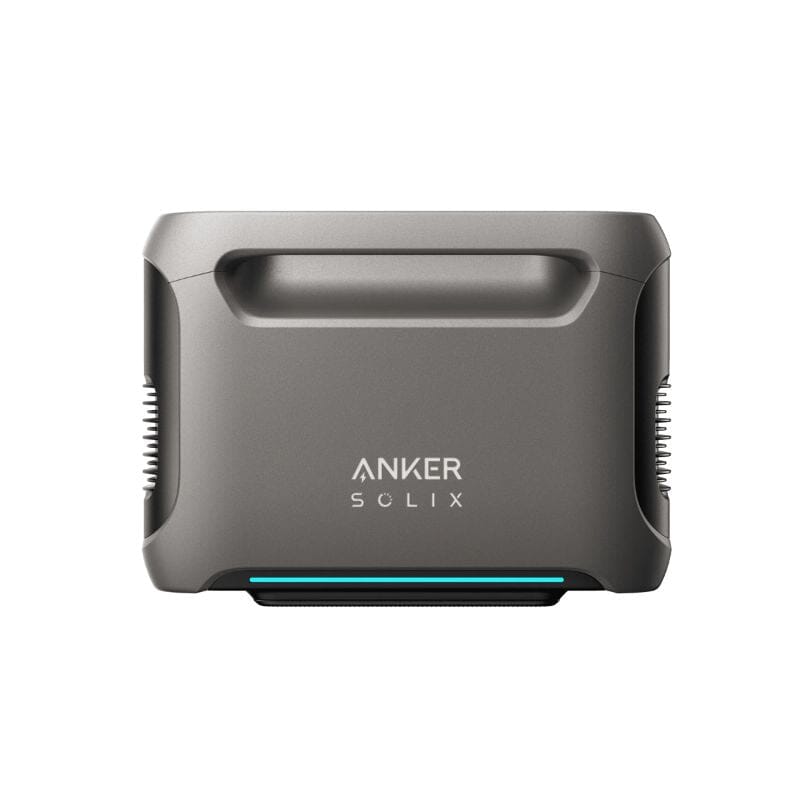
The Anker SOLIX BP3800 Expansion Battery is an add-on battery designed to increase the total storage capacity of compatible Anker SOLIX power stations. It’s built for users who need extended runtime for home backup, off-grid setups, or RV use—but it’s not a standalone power station.
Based on manufacturer documentation and typical performance for this class of expansion battery, this guide breaks down what it can realistically do, who it’s for, and whether it’s worth adding to your system.
Disclosure: This is an informational buyer’s guide based on published specifications, not hands-on testing.
Table of Contents
- What It Is
- Quick Verdict
- Specifications
- What It Can Power (with Host Unit)
- Charging & Solar Expectations
- Day-to-Day Use
- Pros & Cons
- Comparisons
- Runtime Calculator
- FAQs
- Final Recommendation
What Is the Anker SOLIX BP3800 Expansion Battery?

The Anker SOLIX BP3800 Expansion Battery is a high-capacity external battery designed to pair with the Anker SOLIX F3800 power station. It does not have its own inverter or outputs—its sole purpose is to expand total energy storage.
Read my buyer’s guides on the SOLIX F3800 and SOLIX F3800 Plus power stations to see what option suites your needs best.
Who It’s For
- Home backup users needing longer outage coverage
- RV and van setups requiring multi-day runtime
- Off-grid systems with solar charging
Who Should Skip It
- Anyone without a compatible Anker SOLIX base unit
- Users needing a standalone portable power station
- Light-use campers (overkill for short trips)
Quick Verdict

Buy if:
- You already own or plan to buy the Anker SOLIX F3800
- You need significantly longer runtime (multi-day backup)
- You’re building a scalable energy system
Skip if:
- You want portability or a standalone unit
- You only need occasional backup power
👉 Check current price for Anker SOLIX BP3800:
Specifications
| Spec | Value |
|---|---|
| Battery Capacity | 3,840Wh |
| Battery Type | LiFePO4 (LFP) |
| Expandability | Works with Anker SOLIX F3800 |
| Max Expansion | Multiple units supported |
| Output Ports | None (expansion only) |
| Weight | ~60+ lbs (approximate class) |
| Connection Type | Dedicated expansion cable |
| Lifecycle | ~3,000+ cycles (typical for LFP) |
Specs based on official user guide documentation
What Can the BP3800 Power?
Short answer: Nothing by itself.
The Anker SOLIX BP3800 Expansion Battery only increases the runtime of the main power station it’s connected to.
Example with F3800 (Estimated)
- Refrigerator (150W avg):
- Base unit only: ~1–2 days
- With BP3800: ~2–4 days
- Home essentials (lights, WiFi, fans ~300W):
- Base unit: ~10–12 hours
- With expansion: ~20–30+ hours
- RV setup (~800W average):
- Base unit: ~4–5 hours
- With expansion: ~8–12 hours
Actual runtime depends on load efficiency and inverter losses.
Charging Options & Solar Expectations
The expansion battery does not charge independently—it charges through the connected main unit.
Charging Methods (via host unit)
- Wall outlet (AC charging)
- Solar panels (via F3800 MPPT input)
- Generator (pass-through charging)
What to Expect
- Charging time increases proportionally with added capacity
- Solar setups need larger arrays to maintain efficiency
- Full recharge with expansion can take significantly longer than base unit alone
For system planning, see: solar panel sizing for power stations
Day-to-Day Use
The Anker SOLIX BP3800 Expansion Battery is designed for semi-permanent setups rather than frequent movement.
Practical Considerations
- Heavy and not meant for daily transport
- Requires cable connection to base unit
- Expands seamlessly—no manual switching needed
- Best suited for garage, RV bay, or off-grid installation
Pros and Cons
Pros
- Massive 3,840Wh capacity boost
- Scalable system (stack multiple units)
- Long-life LiFePO4 chemistry
- Seamless integration with F3800
Cons
- Not usable without base unit
- Adds significant weight and bulk
- Slower overall recharge with larger system
- High upfront cost
👉 See specs and availability (Amazon)
Comparisons
Expansion Battery Comparison
| Model | Battery Capacity | Compatibility | Weight | Best For |
|---|---|---|---|---|
| Anker BP2000 | 2,048Wh | Smaller SOLIX units | Lighter | Light expansion |
| Anker SOLIX BP3800 | 3,840Wh | F3800 only | Heavy | Whole-home backup |
| EcoFlow Delta Pro Battery | 3,600Wh | Delta Pro | Heavy | Alternative ecosystem |
Key Takeaways
- BP3800 offers higher capacity than smaller Anker expansions
- Comparable to EcoFlow in size, but ecosystem-specific
- Best choice if you’re already committed to Anker SOLIX
Runtime Calculator
To estimate runtime:
Runtime (hours)= Battery Capacity (Wh)×0.85 ÷ Device Wattage (W)
Example
- Total system: 7,680Wh (F3800 + BP3800)
- Load: 300W
Runtime ≈ (7680 × 0.85) ÷ 300 ≈ 21.7 hours
For more scenarios, see: portable power station runtime calculator
FAQs
Can the Anker SOLIX BP3800 run a refrigerator?
Yes—but only when connected to a compatible power station like the F3800. It extends runtime rather than directly powering appliances.
Can it run a microwave?
Indirectly, yes. The main power station must support the microwave’s wattage. The BP3800 simply increases how long it can run.
How long does it take to charge?
Charging time depends on the main unit and input source. Expect significantly longer recharge times compared to the base unit alone, especially with solar.
Final Recommendation
The Anker SOLIX BP3800 Expansion Battery is best suited for users building a large-scale backup or off-grid power system around the F3800. It’s not a casual accessory—it’s a serious capacity upgrade.
Buy it if: you need multi-day runtime and system scalability
Skip it if: you want portability or standalone functionality
Bottom line: A powerful but niche upgrade that makes sense only within a full Anker SOLIX ecosystem.
👉 View current options for Anker SOLIX BP3800: