
Key Takeaways
- This roundup compares several leading solar generators for the same use case instead of relying on a single recommendation.
- Capacity, inverter output, recharge speed, battery chemistry, and price are the main decision points.
- The best choice depends on the appliances being powered, the desired runtime, and how portable the unit needs to be.
- The article helps readers balance runtime, power headroom, and value before choosing a shortlist.
Although most solar generators can work with any type of mini fridge, their battery sizes and recharging speeds affect how long they can realistically run the mini-fridge.
The best solar generator for mini-fridges is the Bluetti AC200P due to its 2,000Wh LiFePO4 battery and 700W maximum solar input. It can run most AC mini-fridges for 2-3 days and 12V DC mini-fridges for 6-7 days before needing to be recharged.
| Ranking | Model | Highlights | Where to Buy |
|---|---|---|---|
| 1. Best Overall | Bluetti AC200P | – LiFePO4 battery (long-lasting) – Large battery – LCD touchscreen | Amazon |
| 2. Best in Versatility | Jackery Explorer 1500 | – Lightweight for size – 500W solar input – Large battery | Amazon |
| 3. Best for 12V Fridge | EcoFlow River Max Plus | – Expandable/removable battery – Fast AC charging – Regulated car output | Shop Solar Kits |
| Ranking | #1 | #2 | #3 |
|---|---|---|---|
| Model | AC200P | Explorer 1500 | River Max Plus |
| Brand | Bluetti | Jackery | EcoFlow |
| Image |  | 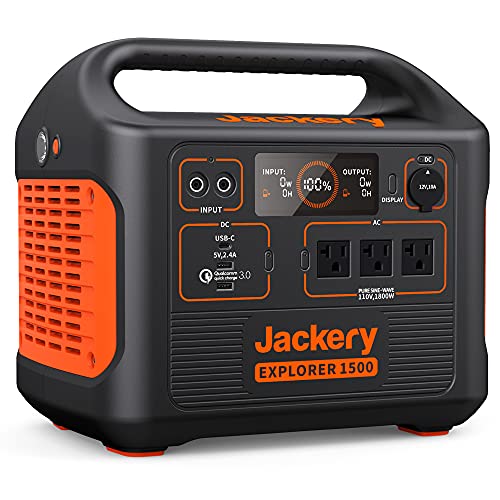 | 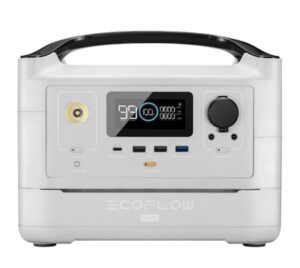 |
| Battery Capacity | 2,000Wh | 1,534Wh | 720Wh |
| Inverter | 2,000W Continuous; 4,800W Surge | 1,800W Continuous; 3,600W Surge | 600W Continuous; 1,200W Surge |
| Price | $1,599 | $1,699 | $599 |
Below, I’ll dive into each model’s specs and features while also showing you their estimated running times with different mini-fridges.
1. Bluetti AC200P
The AC200P is the best solar generator for most mini-fridges because it has enough power to run even the larger compact fridges for extended periods of time.
Since it weighs about 60 pounds, it may not be for everyone. It’s too heavy for most people to carry on their own, so it’s best to leave this unit in a single location.
If you intend to use a 12V DC fridge like the Dometic example below, then it might be best to use one of the smaller options I have listed. The EcoFlow River Max Plus is the ideal option for these types of fridges.
| Refrigerator Model | Midea 4.4 ft³ WHS-160RB1 Compact Refrigerator | RCA 3.2 ft³ RFR321 Mini Refrigerator | Dometic CFX3 45L Portable Refrigerator/Freezer |
|---|---|---|---|
| Yearly Energy Consumption | 226kWh | 193kWh | 110kWh |
| Daily Energy Consumption | 619Wh | 529Wh | 301Wh |
| Usable Hours w/o Recharging | 52 hrs* | 61 hrs* | 128 hrs** |
| Usable Hours w/ Max Solar Input | Unlimited | Unlimited | Unlimited |
The AC200P can run a Midea 4.4 ft³ mini fridge for about 52 hours before you need to recharge its battery. This means that you don’t need a lot of solar panel input power to recharge the power station if you’re charging it daily.
If you intend to use the AC200P on an off-grid weekend getaway or road trip, it can run most mini fridges for the extent of your excursion. However, I recommend reviewing the energy consumption of your fridge before doing this since some models consume more power than the examples I’ve given.
Battery specs
- Cell type: LiFePO4
- Cycle life: 3,500+ cycles to 80% capacity
- Battery capacity: 2,000Wh
Output ports
- 6x 100-120V AC outlets (2,000W continuous, 4,800W surge)
- 1x DC car port (12V, 10A)
- 4x Standard USB-A outputs (15W each)
- 1x USB-C PD output (60W)
- 2x Wireless charging ports (15W each)
- 2x Standard DC outputs (12V, 3A)
- 1x RV DC port (12V, 25A)
Recharging times
- Solar (@ max input of 700W): 3.5-4 hrs
- AC wall (400W): 6-7 hrs
- Car (100-200W): 10 hrs (24V); 20 hrs (12V)
- Dual AC wall (800W): 3-3.5 hrs
- Solar + AC wall (1,100W): 2.5-3 hrs
Size/Weight
- Weight: 60.6 lbs
- Dimensions: 16.5 x 11 x 15.2 in
What stands out?
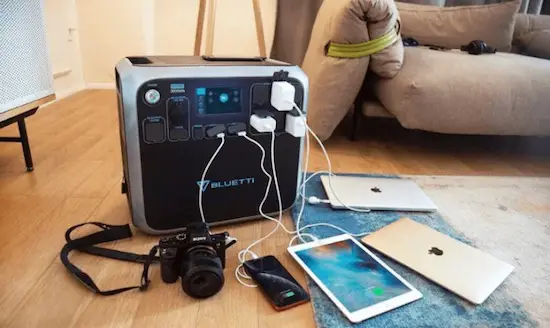
The AC200P has a LiFePO4 battery, which lasts longer than most lithium-ion batteries. It has a rating of 3,500 charge cycles before its battery reaches 80% of its original 2,000Wh capacity. Lithium-ion batteries typically last for about 500 cycles.
This power station also utilizes a touchscreen to navigate its internal specs and features. This feature allows the AC200P to show you more information than nearly any other power station available currently. This is important because you can adjust its settings to your liking.
I recommend this power station to anyone who uses an AC-powered mini fridge because it has enough battery life to run these appliances comfortably.
You can find the Bluetti AC200P on Amazon here (affiliate link) for more details and customer reviews.
2. Jackery Explorer 1500
This Jackery power station is a step up from the company’s previous models due to its size, power, and functionality. I have the slightly smaller Jackery Explorer 1000 and its only advantage to the Explorer 1500 is its lower price and lighter weight.
The Explorer 1500 is the most versatile option for running mini-fridges because it has enough battery life to run all types of mini-fridges yet it weighs two times less than the Bluetti AC200P.
You can maneuver this power station around with relative ease in case you want to use it for different outings. Plus, its 500W maximum solar input allows you to recharge it fast.
Check out its running times with the mini-fridges below.
| Refrigerator Model | Midea 4.4 ft³ WHS-160RB1 Compact Refrigerator | RCA 3.2 ft³ RFR321 Mini Refrigerator | Dometic CFX3 45L Portable Refrigerator/Freezer |
|---|---|---|---|
| Yearly Energy Consumption | 226kWh | 193kWh | 110kWh |
| Daily Energy Consumption | 619Wh | 529Wh | 301Wh |
| Usable Hours w/o Recharging | 40 hrs* | 47 hrs* | 97 hrs** |
| Usable Hours w/ Max Solar Input | Unlimited | Unlimited | Unlimited |
With a 40-hour running time with the larger Midea mini-fridge, this power station might be a better option for you than the previously mentioned AC200P due to the Jackery 1500 coming in at nearly half the weight of the Bluetti model.
However, the Explorer 1500 has an average battery cycle life of 500 cycles, which means it won’t last nearly as long as the AC200P. It also costs $100 more than the AC200P. I’d factor these points into your final decision on which one is best for what you need.
Battery specs
- Cell type: Lithium-ion
- Cycle life: 500 cycles to 80% capacity
- Battery capacity: 1,534Wh
Output ports
- 3x 110V AC ports (1,800W continuous, 3,600W peak)
- 1x DC car port (12V, 10A)
- 1x USB-C PD (60W max)
- 1x USB-A Quick Charge 3.0 port (18W max)
- 1x Standard USB-A port (12W max)
Recharging times
- AC wall charging: 6 hours
- 2x AC wall chargers: 3.5 hours
- Solar charging (at max input of 500W): 3.5-5 hours
- Car charging: 13 hours
Size/Weight
- Weight: 33 lbs
- Dimensions: 14 x 10.4 x 12.7 in
What sets it apart from the competition?
The Jackery 1500 has a unique battery size that isn’t commonly found in current power stations. Its main competitor, the Goal Zero Yeti 1500X, costs about $300 more than Jackery 1500 and is over ten pounds heavier.
Jackery power stations are also known for being relatively easy to use. With its larger LCD screen compared to previous models from the Brand, you can check over its essential data without needing to squint your eyes. If you don’t know what I mean, check out my Jackery Explorer 300 review post, where you’ll see its tiny screen.
I recommend this power station to anyone who wants portability while using their AC mini-fridge. I also recommend it to 12V DC fridge users who want to use it for extended off-grid use since it can run a Dometic CFX3 for over four days before needing to be recharged.
You can check out the Jackery Explorer 1500 on Amazon here for more information (affiliate link).
3. EcoFlow River Max Plus
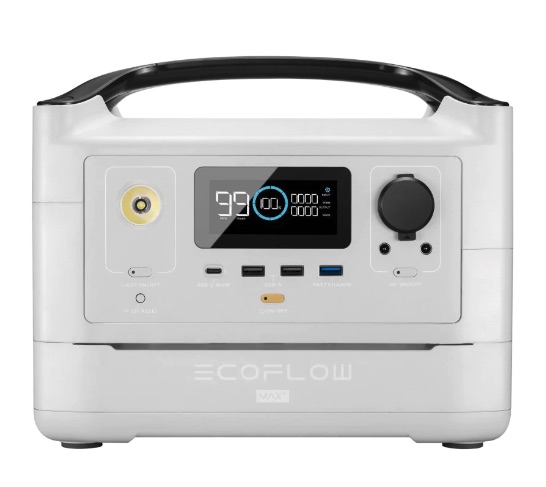
This power station from EcoFlow is the enhanced version of the River Max. The upgraded features include a larger and longer-lasting battery.
I actually have the 1st edition EcoFlow River Max sitting in front of me while I write this post and it’s one of my favorite power stations I’ve tested and reviewed. You can read my review of it here for more information: EcoFlow River 600 Review – Testing My River Max + Comparisons.
As for the River Max Plus, it has the ability to run all of the mini-fridges mentioned below, but it is especially useful when using it with 12V DC fridges. I’ll get into why this is after you get a chance to check out the table.
| Refrigerator Model | Midea 4.4 ft³ WHS-160RB1 Compact Refrigerator | RCA 3.2 ft³ RFR321 Mini Refrigerator | Dometic CFX3 45L Portable Refrigerator/Freezer |
|---|---|---|---|
| Yearly Energy Consumption | 226kWh | 193kWh | 110kWh |
| Daily Energy Consumption | 619Wh | 529Wh | 301Wh |
| Usable Hours w/o Recharging | 19 hrs* | 22 hrs* | 46 hrs** |
| Usable Hours w/ Max Solar Input | Unlimited | Unlimited | Unlimited |
Although you can clearly use the River Max Plus with AC-powered mini-fridges, it’s best used with 12V fridges because it can power them for extended periods of time while weighing only 17 pounds.
This makes it nearly half the weight of the Jackery 1500 model, giving you much more mobility.
Battery specs
- Cell type: NCM Lithium-ion
- Cycle life: 800 cycles to 80% capacity
- Battery capacity: 720Wh
Output ports
- 3x AC ports (600W continuous, 1,200W surge)
- 2x USB-A (5V, 2.4A)
- 1x USB-A Fast Charge (18W max)
- 1x USB-C (100W max)
- 1x Car port (13.6V, 10A)
- 2x DC5521 ports (13.6V, 3A)
Recharging times
- AC wall charger (100-120V): 96 min
- Car charger: 8 hrs
- Solar charging @ max input (200W): 3.6-5 hrs
Size/Weight
- Weight: 17.6 lbs
- Dimensions: 11.4 × 7.3 × 9.3 in
What stands out in the River Max Plus?
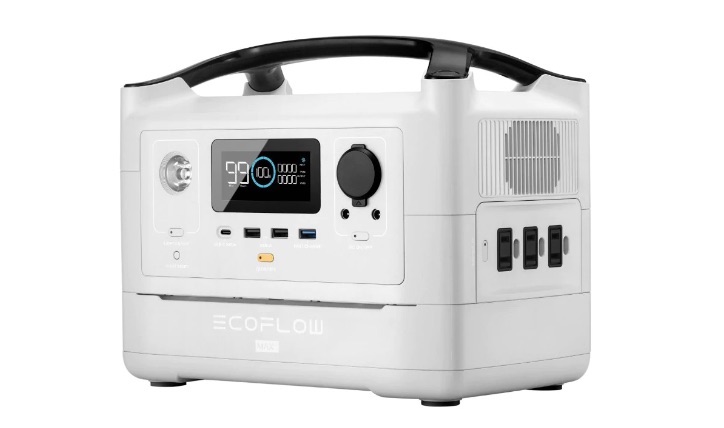
The River Max Plus can be connected to your mobile device via WiFi using the EcoFlow app. This application has many features that I’ve tested with my standard River Max, including:
- Setting the recharging speeds
- Turning on and off its ports
- Reviewing past usage data
If you intend to use your power station and mini-fridge in your home or cabin, this feature may come in handy for you.
However, the mobile app feature is not the reason I put this power station on this list. Its weight and regulated DC outputs are its standout highlights.
The River Max Plus has a 13.6V car port output, which is ideal for running 12V DC fridges. Using the car port output is also beneficial because you retain more battery life as opposed to using the AC ports.
Lastly, you can remove the 360Wh external battery from the bottom of the River Max Plus, which knocks off 5.7 pounds and essentially turns it into the standard River Plus power station. This added layer of portability gives you additional ways to use it if desired.
What size solar generator do I need to run a mini-fridge?
As a general rule, a solar generator with a 1.5-2kWh battery is the ideal size to run a mini-fridge. At this size, most mini-fridges can run for about two days before the solar generator needs to be recharged. Most solar generators can also fully recharge while running a mini-fridge.
By utilizing pass-through charging with a solar generator, it can run a mini-fridge indefinitely depending on how much power is being used to charge it up.
How much electrical energy does a mini-fridge take?
A mini-fridge, as the name implies, will take less electricity to run compared to a big refrigerator. The power consumptions of a mini-fridge vary based on sizes, features, and the manufacturer.
Here are some estimated annual wattages of some popular mini-fridges:
- 1.7 Cu Ft Mini Fridges: 208 kWh
- 3.3 Cu Ft Mini Fridges: 220 kWh
- 4.4 Cu Ft Mini Fridges: 228 kWh
To get an accurate knowledge of your mini-fridge, you might need to check its manual as there are variances in energy consumption.
How many watts does a mini-fridge use per day?

Most AC-powered mini-fridges use between 500 and 800 watt-hours of power per day. Mini fridges with an Energy Star rating tend to be on the lower end of this spectrum, using about 500-650 watt-hours per day.
If your mini-fridge is an older model or doesn’t have an Energy Star, be sure to review its energy consumption, which can be found either on its attached label or online.
How much solar do I need for a mini-fridge?
A steady solar panel input of 150-200W can keep a mini-fridge running daily via a solar generator. This amount of solar power keeps the solar generator’s battery charged up while using it with a mini-fridge.
However, it’s important to use a solar generator with a large enough battery to run the mini-fridge at night.
There are several types of mini-fridges available today that consume various amounts of power. There are standard mini-fridges, 12V models, and compact fridges for keeping just a few cans of your favorite beverages cold.
Mini-fridges you can use off the grid with a solar generator
There are several differences among my three options given below, but the main variation is each mini fridge’s size.
The best mini fridge for use with a solar generator is the RCA single door mini fridge because it has a 5-star Energy Star rating, a large internal volume of 3.2 cubic feet, and is one of the least expensive mini fridges for its size, at $155.
It also has over 11,000 reviews on Amazon with an average score of 4.4/5. However, the RCA mini fridge may be too large for your specific needs. That being said, I’ve included two smaller models as well.
1. RCA single door mini-fridge with freezer

The RCA mini fridge with a freezer is an ideal system to have on an off-grid cabin if you do not need a full-size fridge.
It can also be a secondary fridge if you have a larger cabin and would like the additional room to refrigerate needed foods and beverages.
Here’s how the RCA mini fridge compares to other models with similar internal volume sizes (3.1-3.2 cubic feet):
| Model | RCA Mini Fridge | Midea Compact Refrigerator | TECCPO Mini Fridge | Euhomy Mini Fridge |
|---|---|---|---|---|
| Cubic Feet | 3.2 | 3.1 | 3.2 | 3.2 |
| Rating on Amazon | 4.4/5 (11,000+ ratings) | 4.6/5 (3,500+ ratings) | 4.5/5 (400+ ratings) | 4.6/5 (1,000+ ratings) |
| Energy Star? (Y/N) | Y | N | Y | N |
| Price | $155 | $200 | $170 | $210 |
As you can see from the comparison table, the RCA mini fridge is the least expensive out of the similar models mentioned.
Main specifications
- Capacity: 3.2 Cubic Feet
- Freezer capacity: 0.2 cu. Ft.
- Energy Star: Yes
- Overall dimensions: 17.5 x 18.75 x 32.75 inches
- Weight: 43.6 lbs
2. ICECO JP40 mini-fridge
The ICECO JP40 mini-fridge works with a 12/24V DC and 100-240V AC power source.
Also, the refrigerator features a 3 stage dynamic battery protection system that will meet your needs and protect your solar generator’s battery or vehicle battery.
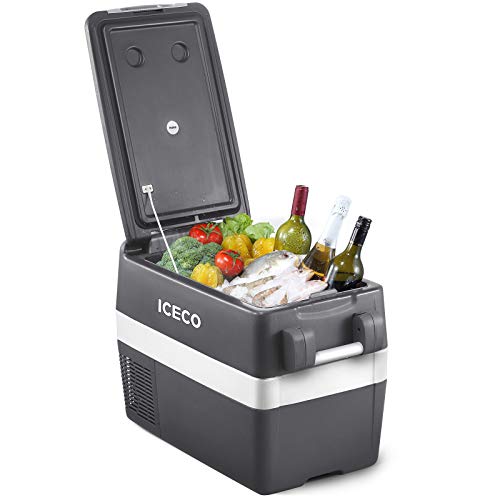
Other added features include side-grip handles, an insulated protected bag, and a compact design.
The handles allow for a secure grip and easy portability as they are made from quality and durable materials to prevent breakage.
As for the insulated protected bag, it primarily helps easy transport. All of the features of this generator make it perfect for outdoor applications.
Inside the ICECO mini-fridge, there is a wire basket that enables you to maximize space and efficiently store food, drinks, and other essentials.
With this generator, hunters and other lovers of outdoor activities will have a fantastic experience. Other features include its large capacity, fast cooling, and lead display and touch control.
Main specifications
- Capacity: 1.41 Cubic Feet
- Amperage: 4.5 Amps
- Voltage: 12 Volts
- Minimum Temperature: 0.4 Fahrenheit
- Maximum Temperature: 15 degrees Fahrenheit
- Overall dimensions: 17.52 x 23.03 x 13.8 inches
- Interior dimensions: 17.5 x 13.8 x 23 inches
- Depth (Excluding Handles): 23 inches
- Depth with Door Open at 90 Degrees: 17.3 inches
- Weight: 34.2 lbs
3. Caynel personal mini-fridge

Interestingly, the Caynel mini-fridge refrigerates about six 12oz. cans, and it’s perfectly portable for personal use. It’s a tiny-sized fridge with a premium design.
Main specifications
- Capacity: 0.14 Cubic Feet
- Minimum Temperature: 32 degrees Fahrenheit
- Maximum Temperature: 140 degrees Fahrenheit
- Overall dimensions: 7.2″ W x 9.95″ D x 10.83″ H
- Interior dimensions: 5.3″ L x 5.5″ D x 8.3″ H
- Weight: 5 lbs
An admirable feature of the Caynel mini-fridge is its portability.
The Caynel mini-fridge allows for easy switching from beverage cooler to food warmer. With the flip of a switch, you can choose whether to use it to warm up or cool specific food products.
Interestingly, for this fridge, the semiconductor is very energy-efficient, quiet, and environmentally friendly. Additionally, it is 100% Freon-Free, and ETL approved with advanced safety technology for durability.
This Caynel fridge has both AC 110V home outlet and the regular 12V car charger. Those features allow you to use this fridge at home and also outdoors (on the road).
The Caynel is multifunctional. Surprisingly, with its 4-liter capacity, it’s great for storing lots of food products. Therefore, you can comfortably store food, drinks, breast milk, beer, snacks, wine, and all other essentials.
Powering your mini-fridge off the grid (step-by-step)
A solar generator has three core elements that allow it to run your mini-fridge for days/weeks on end (depending on the model you choose): a battery, AC inverter, and a solar panel charging input.
A solar generator of the right size can power a mini-fridge for days or longer depending on the solar input you have connected to the generator.
How to calculate the daily power consumption of a mini-fridge
Here’s an example of sizing your fridge to a solar generator that will work well with it. Let’s say we want it to run for at least a week completely off the grid.
I’m using the Midea 3.1 Cu. Ft. Compact Refrigerator as an example, and its energy use per year is 270kWh per year (as seen below).
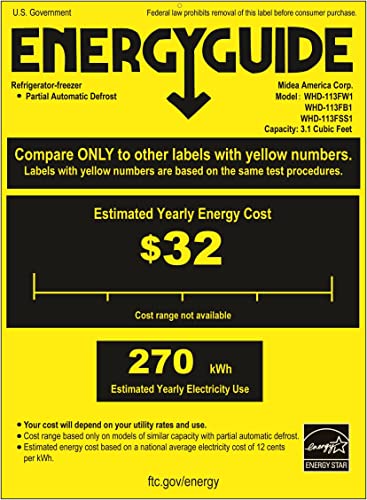
Using this number, we need to find out the daily watt-hour (Wh) usage the mini-fridge consumes. This will help align us to a solar generator that will be able to power the fridge for several days if needed.
Taking 270Wh divided by 365 days gives us 0.739kWh of daily usage needs.
Multiply this by 1,000 to get the daily watt-hour consumption, which is 739Wh. Watt-hours are what solar generators use to determine their battery capacity.
Matching a solar generator to a mini-fridge
Playing it safe, I want to get a solar generator that has about double the strength of what the fridge consumes in a single day. Therefore, the best option for this mini fridge is a solar generator with about 1,500Wh of battery capacity.
The generator that I think has the best value in this battery size category is the Bluetti EB150. It has a 1,500Wh battery.
This means that without any solar panels to recharge the generator battery, the mini-fridge in this example will run for about two full days.
Finding the right solar panel input
In order for the Midea mini-fridge to run consistently for days on end, it must have a solar generator with a solar input great enough to keep the battery powering the fridge.
Since the Bluetti EB150 has a maximum solar input of 500W, it will be able to recharge itself fully before nightfall – allowing it the ability to easily power the mini-fridge all night.
Why a solar generator might be the best option to power a mini-fridge
The truth is fuel-enabled electricity, aka gas-powered generators, are loud for any type of indoor use and may not be the type of generator you’d want to have to power your mini-fridge and/or other appliances and electronics.
Hence the need to get a solar generator to power your mini-fridge.
That said, a medium-sized solar generator with about 1,400Wh of capacity, when fully charged, can power a mini-fridge alone for about 48 hours, if not more. What this means is that:
- You need not worry about power outages and contents within the fridge getting spoiled in the process
- There are no accumulated electricity bills to pay
- It is easier to manage without the fear of high voltage because the inverter regulates this